From Classroom to Triage: A No‑BS Cybersecurity Roadmap for 2026
Visual Roadmap: Your Cybersecurity Journey at a Glance
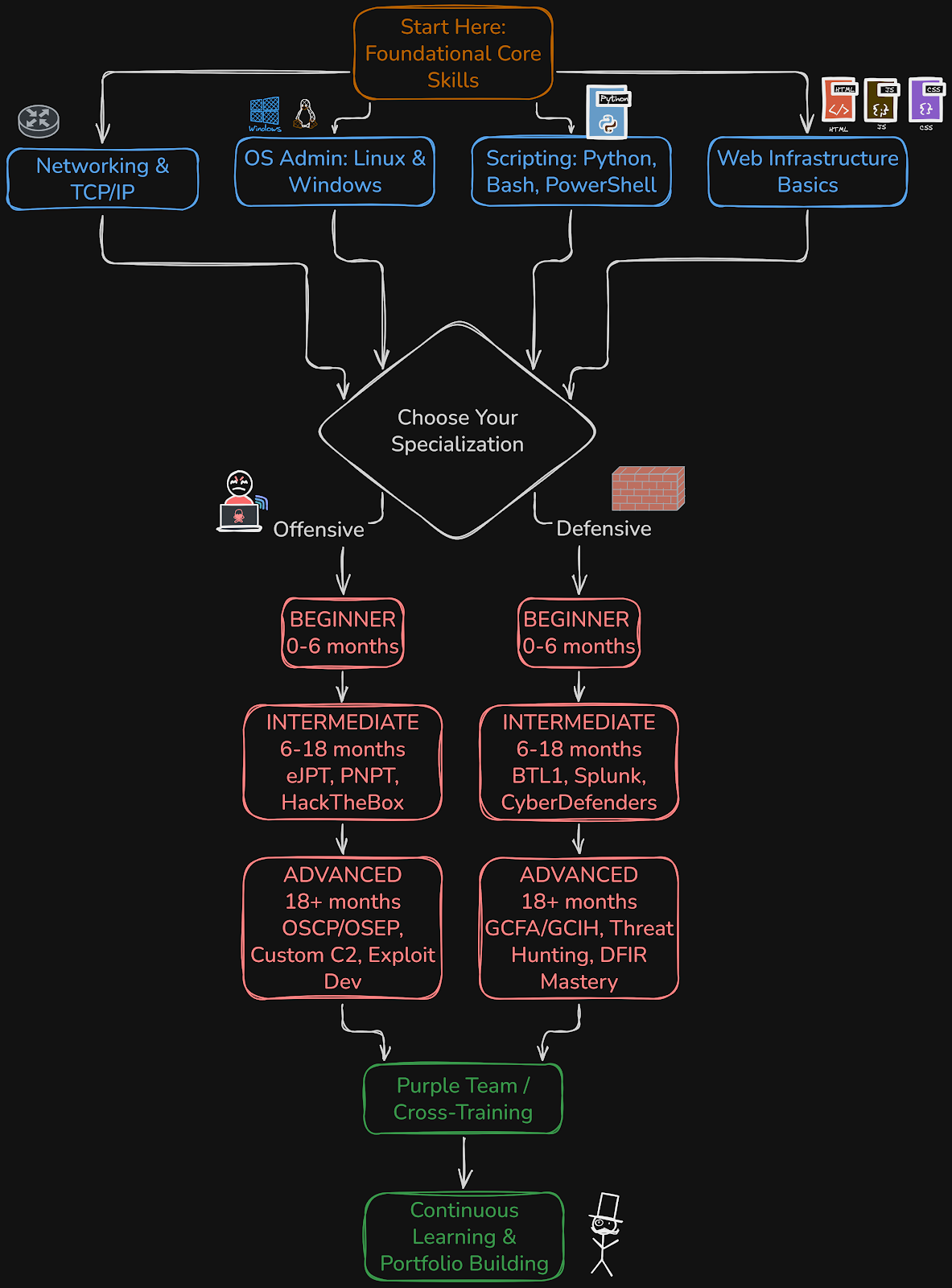
Executive Summary
University curricula teach you the OSI model and the syntax of Python, but they rarely show you how to triage a phishing incident at 3 a.m. or how to pivot through a segmented network using a compromised web server.
The result is a painful gap: graduates know about cybersecurity but cannot do cybersecurity. This writeup crafted for students, beginners, and early career practitioners provides a brutally honest, structured, and hands on roadmap. You will learn the foundational core that every security professional shares, then choose an offensive or defensive specialization track, progress through realistic timelines, and finally see exactly how to build a portfolio that hiring managers actually read. No fluff, no gatekeeping, just the path that turns academic knowledge into operational skill.
1. Foundational Core Skills (Shared Prerequisites)
Before you decide to break things or defend them, you must speak the language of the infrastructure you will be attacking or protecting. These four domains are non negotiable and serve every cybersecurity role.
1.1 Networking (TCP/IP, OSI Model, Routing/Switching)
⚠️ Pitfall Alert: Many learners jump directly to tools like Nmap before truly understanding the TCP three way handshake. If you can’t explain why a SYN scan differs from a TCP connect scan, you’re not ready. Master the fundamentals before touching any tool.
What to learn :
- The OSI model as a troubleshooting tool, not just a memorised diagram. Know how data flows from L7 down to L1 and back.
- TCP/IP in depth: three way handshake, sequence numbers, windowing, flags (SYN, ACK, FIN, RST, PSH, URG), and how they are abused in attacks like SYN floods or session hijacking.
- Subnetting and CIDR. Be able to calculate network ranges in your head critical for firewall rule analysis and lateral movement.
- Common protocols: DNS (recursive vs. authoritative, tunneling), HTTP/HTTPS (methods, headers, cookies), SMTP, FTP, SMB, SSH, and their default ports.
- Traffic analysis with Wireshark/tcpdump. Read a pcap and reconstruct a conversation.
Lesson from the Field: The OSCP Who Couldn’t Subnet :
A candidate with OSCP, PNPT, and a top Hack The Box rank failed a senior pentester interview. Asked on a whiteboard why 192.168.1.0/24 has 254 usable hosts and how CIDR matters for network pivoting, he stumbled. The panel concluded he relied too heavily on automation without understanding the underlying network layer. He later rebuilt his networking knowledge from scratch and got the job three months later. Don’t skip the basics; they will test you on them.
Translation to roles :
- Offensive: You craft packets with Scapy, evade firewall rules with fragmented packets, perform ARP spoofing, and exfiltrate data over DNS.
- Defensive: You hunt C2 beacons by spotting periodic DNS requests, detect port scans via threshold alerts in Zeek, and trace lateral movement through NetFlow data.
1.2 Operating Systems (Linux Administration & Windows Internals)
-
Linux :
Command line proficiency: file manipulation, permissions, process management (ps, top, htop), systemd services, cron jobs.
Filesystem hierarchy (FHS), log locations (/var/log), and how to audit authentication (auth.log, secure).
Bash scripting for automation: log parsing, user creation, backup scripts.
Kernel modules, namespaces, and cgroups (the foundation of containers). -
Windows :
NTFS permissions, registry structure, and event logs (Security, System, Application).
Windows internals: processes, threads, handles, DLLs, LSASS, SAM database.
PowerShell for administration and security tasks: Get WinEvent, Get Process, remote management.
Active Directory basics: domains, OUs, GPOs, Kerberos authentication, and common attacks (Kerberoasting, Pass the Hash).
Translation to roles :
- Offensive: You exploit weak service permissions on Linux, dump LSASS memory on Windows, and use PowerShell to run fileless malware.
- Defensive: You harden systems via GPOs, configure audit policies (command line logging, PowerShell module logging), and investigate suspicious process trees using Sysmon.
1.3 Scripting/Programming (Python, Bash, PowerShell)
Minimum proficiency :
- Python: read/write files, make HTTP requests (requests library), parse JSON/XML, interact with APIs, and automate repetitive tasks (scanning subnets).
- Bash: loops, conditionals, grep/awk/sed for log mining.
PowerShell: cmdlets for system interrogation, script block logging awareness, and basic automation.
Translation to roles :
- Offensive: You write custom exploit scripts, build C2 stagers, and fuzz web parameters.
- Defensive: You automate IOC extraction from threat intel feeds, write detection rules (Sigma), and orchestrate SOAR playbooks.
1.4 Web Infrastructure Basics
- How web servers (Apache, Nginx, IIS) handle requests and serve content.
- HTTP request/response structure, status codes, sessions, cookies, and the role of headers (CORS, CSP, HSTS).
- Client side technologies: HTML, JavaScript, and how DOM manipulation can lead to XSS.
- Database basics: SQL syntax (SELECT, INSERT, UNION) and how ORMs can mask injection risks.
- Authentication and authorisation models: OAuth2.0, JWT misuse.
Translation to roles :
- Offensive: You chain SQL injection to RCE, exploit insecure deserialisation, and abuse OAuth misconfigurations.
- Defensive: You deploy WAF rules, review CSP headers, and analyse web logs to spot credential stuffing patterns.
2. Specialization Tracks (Offensive vs. Defensive)
With the foundation in place, you choose a primary track. Deepen your skills in one while maintaining awareness of the other; later you can pivot as described in Section 5.
A) Offensive Security Track (Red Teaming / Pentesting)
2A.1 Web Application Security :
-
Key concepts: OWASP Top 10 (2021), injection attacks, broken authentication, sensitive data exposure, XXE, broken access control, security misconfigurations, XSS, insecure deserialisation, using components with known vulnerabilities, insufficient logging & monitoring.
-
Tools: Burp Suite Professional/Community (Repeater, Intruder, Collaborator), OWASP ZAP, sqlmap, ffuf/gobuster, Postman, Caido.
-
Certifications: eWPT, OSWA, practical exams that require live exploitation.
-
Platforms: PortSwigger Web Security Academy (free, excellent), PentesterLab (code based), Hack The Box (web challenges), TryHackMe (Web Fundamentals path).
2A.2 Network & Infrastructure Pentesting :
⚠️ Pitfall Alert: Never run a vulnerability scanner or exploit against any system without explicit, written permission. Unauthorized scanning can be a criminal offence, even on bug bounty platforms, scoping is everything. Always confirm the rules of engagement.
⚠️ Pitfall Alert: Metasploit is a fantastic tool, but if you cannot manually craft an exploit or use Netcat for a reverse shell, you’re a script kiddie. Always learn the manual method first; use frameworks only to accelerate proven techniques.
-
Methodology: Reconnaissance (passive/active), scanning (Nmap, masscan), enumeration (SMB, SNMP, LDAP), vulnerability analysis (Nessus, OpenVAS), exploitation (Metasploit, manual exploit modification), post exploitation (lateral movement, persistence).
-
Tools: Nmap, Metasploit, Netcat, Impacket suite (secretsdump, wmiexec, smbexec), CrackMapExec, Mimikatz, BloodHound (for Active Directory attack paths).
-
Certifications: PNPT (TCM Security heavily AD focused, practical), eJPT (entry level), OSCP (industry gold standard), OSEP (evasion).
-
Platforms: TryHackMe (Offensive Pentesting path), Hack The Box (Pro Labs Dante, Rastalabs), Proving Grounds (Play/Practice).
2A.3 Wireless Security :
-
Fundamentals: 802.11 frame types, WPA2/WPA3 handshakes, PMKID attacks, rogue access points, evil twin attacks, Bluetooth (BLE) sniffing.
-
Tools: Aircrack ng suite, Bettercap, hcxdumptool/hcxpcapngtool, Wifite, Kismet.
-
Practice: Hardware like Alfa AWUS036ACH adapter; practical wireless labs on Wi Fi Challenge (Wi Fi Security Academy) or custom home lab with old routers.
2A.4 Reverse Engineering & Exploit Development :
-
Binary exploitation: Buffer overflows (stack, heap), format strings, ROP chains, ASLR/DEP bypass, SEH overwrite.
-
Reverse engineering: Static analysis (Ghidra, IDA Free), dynamic analysis (x64dbg, GDB with pwndbg), unpacking malware.
-
Tools: pwntools, Ropper, checksec, mona.py.
-
Certifications: OSED (Exploit Dev), eCXD.
-
Platforms: pwn.college, Crackmes.one, Exploit Education (Protostar, Fusion).
B) Defensive Security Track (Blue Teaming / SOC)
2B.1 Security Monitoring & SIEM Operations :
-
Core: Log collection, parsing, correlation, and alert triage. Understand log sources: Windows Event Logs (4624, 4625, 4688, 7045, Sysmon 1,3,7,11), Linux auth/firewall logs, network flows, endpoint telemetry.
-
SIEM tools: Splunk (free dev license), Elastic Security (ELK Stack), Wazuh (open source XDR), Microsoft Sentinel (free tier available).
-
Certifications: BTL1 (practical SOC analyst), Splunk Core Certified User/Power User, Security+ (foundational).
-
Platforms: Blue Team Labs Online (investigations, challenges), CyberDefenders (blueteam CTFs), LetsDefend (SOC simulations).
2B.2 Incident Response (IR) :
-
Process: Preparation, identification, containment, eradication, recovery, lessons learned (SANS PICERL).
-
Hands on skills: Live forensics (volatility3, KAPE, Velociraptor), memory analysis, log timeline creation (Plaso/log2timeline), chain of custody, writing incident reports.
-
Tools: Velociraptor, TheHive/Cortex, SOAR platforms (Shuffle, n8n for automation).
-
Certifications: GCIH (SANS, incident handling), ECIH (EC Council, but recommend SANS), CISSP (more managerial).
2B.3 Threat Hunting :
-
Hypothesis driven hunting: Develop hypotheses based on MITRE ATT&CK techniques, then query data lakes (Splunk, Elastic) for indicators.
-
Techniques: Beacon detection (time deltas, jitter), unusual process parent child relationships, PowerShell obfuscation, WMI abuse.
-
Tools: Sysmon, Zeek (Bro), RITA (Real Intelligence Threat Analytics), YARA rules for file/memory patterns.
-
Platforms: TryHackMe (SOC Level 1/2), Huntress CTFs, malware traffic analysis net.
2B.4 Digital Forensics & Incident Response (DFIR) :
-
Disk forensics: File system analysis (NTFS, ext4), recovery of deleted files, timeline building, registry analysis (Shellbags, ShimCache, AmCache).
-
Memory forensics: Volatility3 plugins for process listing, network connections, injected code, registry keys, malware detection.
-
Mobile forensics: Android/iOS basics (IFT tools).
-
Certifications: GCFA (forensics), CHFI (EC Council, less hands on), BTL2 (advanced blue team).
-
Platforms: Digital Forensics Corp. images, NIST CFReDS, CyberDefenders forensic challenges, aboutdfir.com for resources.
Offensive vs. Defensive Mindset: A Suspicious SMB Connection
| Stage | Offensive Security (Red Team) | Defensive Security (Blue Team) |
|---|---|---|
| Trigger | Discovered open SMB port during a network scan. | SIEM alert: multiple SMB session setups from a single internal IP. |
| First Thought | Can I enumerate shares, exploit EternalBlue, or relay authentication? | Is this a worm, lateral movement, or a misconfigured backup script? |
| Tools & Data | Nmap smb-enum-scripts, CrackMapExec, Impacket, Metasploit. | Wireshark, Zeek conn.log, Splunk search, Sysmon Event IDs 3 & 7. |
| Key Question | What OS version? SMB signing disabled? Anonymous login allowed? | What user account? Was this a privileged operation? Is the source host trusted? |
3. Progression Roadmap & Realistic Timeline
This is a phased plan, not a race. Consistency beats intensity.
Beginner (0-6 months):
Build the Trunk
-
Focus areas: Foundational Core Skills (Section 1). Obtain Network+ or equivalent knowledge; Linux command line (aim for RHCSA level comfort, not the exam); Python scripting to automate basic tasks; Web basics.
-
Hands on: Set up a home lab with VirtualBox/VMware a Kali Linux attacker, a Metasploitable2 target, a Windows 10 VM, and a Security Onion sensor. Attack and observe traffic.
-
Certifications: Consider CompTIA A+ and Network+ if starting from scratch, otherwise Security+ to learn security vocabulary.
-
Timeline: 4-6 months at 10-15 hours per week.
Intermediate (6-18 months):
Choose a Branch
Focus areas: Pick either offensive or defensive track. Dive into the tools and platforms.
-
Offensive: Complete TryHackMe Jr Penetration Tester path, then eJPT or PNPT study, followed by Hack The Box active machines (starting with easy).
-
Defensive: Earn BTL1 or equivalent; build a home SOC using ELK/Splunk with simulated attacks; complete CyberDefenders challenges.
-
Soft skills: Write concise walkthroughs for every challenge you solve; start a blog or GitHub writeup repository.
-
Certifications: eJPT/PNPT for offensive, BTL1 for defensive. Begin OSCP preparation if going offensive.
-
Timeline: 6-12 months after beginner phase.
Advanced (18+ months):
Specialize and Harden
Focus areas: Active Directory attacks and detection, advanced evasion, threat intelligence pipelines, or deep forensics. Choose a sub specialty.
-
Offensive: Pursue OSCP/OSEP; exploit development; custom C2 development; contribute to open source tools.
-
Defensive: Develop custom detection rules (Sigma, YARA); master SOAR automation; perform enterprise scale threat hunts; GCFA/GCIH.
-
Portfolio peak: Demonstrate a complete red team operation or an original detection engineering project (a Splunk app that spots novel LOLBin abuse).
-
Timeline: Ongoing. The learning never stops.
4. Learning Resources & Community Engagement
Open source/free resources :
-
Books: “The Web Application Hacker’s Handbook” (Stuttard/Pinto), “Practical Packet Analysis” (Sanders), “Rtfm: Red Team Field Manual” (Clark), “Blue Team Field Manual” (Murdoch).
-
Documentation: MITRE ATT&CK®, OWASP Cheat Sheets, Microsoft Sysmon and Windows Internals docs, Red Hat Linux documentation.
-
Video/Labs: Professor Messer (free Security+), The Cyber Mentor (YouTube), John Hammond (CTF walkthroughs), STÖK (bug bounty), IppSec (Hack The Box writeups).
-
Platforms: TryHackMe (free/student tiers), Blue Team Labs Online (free tier), CyberDefenders (free), PortSwigger Academy (completely free), Hack The Box (free starting point machines).
Global Communities :
r/cybersecurity, r/netsec, r/AskNetsec, r/homelab.
The Cyber Mentor, TCM Security, Hack The Box, Blue Team Labs Online.
DEF CON, Black Hat, BSides (local chapters), SANS CTFs.
Look for local OWASP chapters, ISACA/ISC² meetings, national CERTs.
| Weeks | Weeks | Platform / Lab | Project Goal |
|---|---|---|---|
| 1-2 | Practical Packet Analysis (Ch. 1-5) | TryHackMe - Pre Security Path | Capture a complete 3-way handshake and explain each flag in a Wireshark writeup. |
| 3-4 | OWASP Top 10 (read summaries) | PortSwigger Web Security Academy - SQL Injection labs | Manually find and exploit a SQLi in a lab; write a detailed report with remediation. |
| 5-6 | Microsoft Sysinternals Documentation | VirtualBox: Windows 10 VM + Sysmon installation | Create a Sysmon configuration that logs process creation and write a detection rule for a suspicious binary. |
| 7-8 | Blue Team Field Manual (selected sections) | Blue Team Labs Online - Investigating a Phishing Email challenge | Complete the challenge, extract all IOCs, and publish a short incident report on your blog. |
5. Deep Technical Insights & Advanced Questions (DeepSeek’s Insights Section)
5.1 How to smoothly transition between Offensive and Defensive roles mid career :
A mid career pivot is not a reset; it’s a transfer of mental models. An attacker who knows how to exfiltrate via DNS tunneling will design stronger detection rules for high entropy subdomains. A defender who can reconstruct incident timelines will prioritize stealth and log evasion during a red team exercise.
Practical steps:
-
Leverage overlap: Both roles require deep protocol understanding and scripting. Focus on the skill intersection network traffic analysis, log forensics, and system internals rather than tools.
-
Earn a bridging certification: An OSCP holder transitioning to blue might pursue BTL2/GCIH to learn IR methodology. A SOC analyst moving to red could get eJPT to learn structured pentesting.
-
Build a hybrid project: Create a lab where you run an attack, capture all telemetry, then build detection and response playbooks. Document the kill chain and the corresponding Sigma rules. This project alone proves dual competency.
-
Apply to roles that value cross training: Managed security service providers (MSSPs), small security consultancies, and internal “Purple Team” positions actively seek individuals with both mindsets.
5.2 Balancing deep specialization vs. broad skill diversity (T shaped skill profile) :
The T shaped professional has broad foundational knowledge (the horizontal bar) and deep expertise in one domain (the vertical stem). Early in your career, breadth keeps you agile; later, depth increases your value.
-
Broadening phase (first 18 months): Rotate across web, network, cloud, and basic forensics. You’ll discover what you enjoy and what the market needs.
-
Deepening phase: Choose a stem cloud security, Active Directory attack/defense, DFIR, reverse engineering and spend deliberate practice. Write tools, contribute to open source projects, present at local meetups.
-
Maintain breadth through curiosity: Even as a deep dive incident responder, stay aware of cloud security changes. Set aside 10% of learning time for adjacent domains via newsletters (SANS NewsBites) and quarterly CTFs.
5.3 Emerging future trends and their skill requirements :
-
AI in Cybersecurity: Offensive AI will automate phishing campaigns and find zero day variants; defensive AI aids in anomaly detection. Required skills: Python data science stack (pandas, scikit learn), understanding adversarial ML, and building detection ML pipelines (Splunk Machine Learning Toolkit, Elastic ML jobs). Don’t chase buzzwords understand how log based models can be poisoned and how to validate AI generated alerts.
-
Cloud Security: The perimeter is gone. Skills: IAM policy analysis, cloud native logging (AWS CloudTrail, Azure Monitor), container orchestration security (Kubernetes RBAC, pod security policies), infrastructure as code scanning (Checkov, tfsec). Certifications like AWS Security Specialty or CCSK provide structure.
-
IoT/OT Security: Industrial protocols (Modbus, DNP3, MQTT) lack authentication. Learn network segmentation (Purdue model), protocol analysis with Wireshark, and passive monitoring tools (GRASSMARLIN). OT pen testing requires extreme caution to avoid disrupting physical processes. Hands on with cheap IoT devices and the ATT&CK for ICS matrix.
5.4 Fatal mistakes beginners make during skill acquisition and how to avoid them :
⚠️ Pitfall Alert: Earning five certifications without a single hands on lab project makes you a paper tiger. Employers want proof of applied skill, not just exam passes. Every certification must be backed by public evidence of practical work.
- Tool first, fundamentals later: Memorizing Metasploit modules without understanding TCP handshakes leads to “script kiddie” syndrome.
- Fix : For every tool, pause and ask “What is happening on the wire/disk?” and replicate the effect manually (a Netcat reverse shell before Metasploit).
Lesson from the Field: Five Certs, Zero Labs :
A job seeker held Security+, CySA+, CEH, and Splunk Core certifications but had never performed a real log analysis outside exam simulators. In a practical interview, he was asked to triage a malware alert using a sample pcap. He couldn’t identify the beaconing pattern and couldn’t use Wireshark beyond basic filters. His resume was discarded. Certifications open doors; practical portfolios land jobs.
- Certification chase without practical application: A resume with five certs but zero labs screams paper tiger.
- Fix: For each certification, build a publicly documented project that uses at least 60% of the exam objectives.
- Ignoring documentation: Solve a box with a walkthrough but cannot explain the underlying vulnerability.
- Fix: Write your own step by step guide and the “why” behind each step; teach a peer.
- Not failing enough: Staying only in comfortable challenges.
- Fix: Attempt machines well above your level for 2-4 hours before seeking hints. The struggle etches knowledge deeper than any tutorial.
- Over optimizing the learning path: Spending more time planning “the perfect roadmap” than executing.
- Fix : Pick one resource and go deep until completion before evaluating the next.
5.5 Building a proof of concept practical Portfolio (GitHub, Writeups, Home Labs) that catches the attention of hiring managers
A portfolio is your tangible proof of work. It must demonstrate process, not just outcomes.
Components:
-
GitHub repositories: Organized, with clean README files. Include:
- Detection rules: Sigma rules for novel attack techniques (with test scripts).
- Automation scripts: A Python script that parses firewall logs and outputs IOC list.
- CTF writeups: Not just paste fest; explain the thought process, dead ends, and lesson learned. Use a blog (Jekyll/Hugo hosted on GitHub Pages) for long form.
-
Home lab diagram & story: An architecture diagram (Draw.io) of your lab (AD forest, SIEM, vulnerable services). Document an attack scenario and how you detected/responded. Treat it as an incident report.
-
Threat intelligence reports: Choose a recent malware campaign, recreate indicators, and write a 2 page report with MITRE ATT&CK mappings.
-
Video demonstrations: A 5 minute Loom video walking through your Splunk dashboard hunting for Kerberoasting events adds a human touch.
- Presentation: Link the portfolio in your resume header. When asked in interviews, narrate the problem you solved, not just the tools. Example: I built a lab to simulate an Emotet infection, extracted IOCs, and created automated response playbooks that reduced mean time to contain (MTTC) by 40%. That’s the narrative that lands offers.
6. Conclusion & References :
The journey from academic theory to industry ready practitioner is a marathon structured by sprints. You must first build a trunk of networking, OS, scripting, and web fundamentals. Then branch into offensive or defensive tracks, advancing through beginner, intermediate, and advanced phases with deliberate practice, certifications, and a living portfolio. The cybersecurity field rewards those who can do, not just know. Your labs, writeups, and projects are the irrefutable evidence.
Curated References :
- PortSwigger Web Security Academy: https://portswigger.net/web security
- TryHackMe: https://tryhackme.com
- Hack The Box: https://www.hackthebox.com
- Blue Team Labs Online: https://blueteamlabs.online
- MITRE ATT&CK: https://attack.mitre.org
- OWASP Top Ten: https://owasp.org/www project top ten/
- Pwn College: https://pwn.college
- Practical Network Penetration Tester (PNPT) by TCM Security
- BTL1 (Blue Team Level 1) by Security Blue Team
- SANS DFIR posters: https://digital forensics.sans.org/community/posters
- “The Web Application Hacker’s Handbook” 2nd Edition, Stuttard & Pinto
- “Red Team Field Manual” (RTFM) by Ben Clark
- “Blue Team Field Manual” (BTFM) by Alan J. Murdoch
- Splunk Free License: https://www.splunk.com/en_us/download.html
- Elastic Security: https://www.elastic.co/security
Comments
Loading comments…